MOF ✖ Dvořák - The coexistence of spaciousness and strength
已更新:9月17日
* Background reading music curated for this article is available at the bottom. Click to enjoy
MOF Material Characteristic
MOF is mostly known for its highly-porous structure. First found in 1995, Omar M. Yaghi used carboxylate-based linkers to demonstrate the crystallization of MOF. However, in this stage, MOF materials cannot maintain a stable porous structure. Thus, later in 1998, Omar introduced the concept of secondary building units, simplified as SBUs, which are metal-carboxylate clusters that are rigid enough to help MOFs retain porosity in any conditions. The first MOF that exhibits ultra-high porosity identity if MOF-5, which is constructed by zinc oxide clusters and terephthalate linkers.
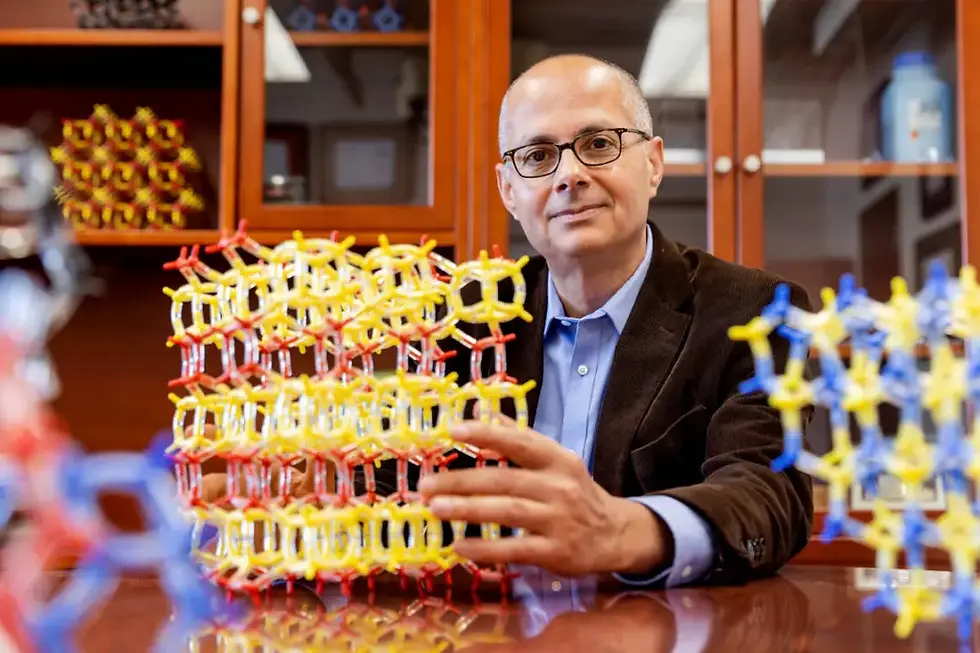
Omar with his MOF structural model
I admit that merely talking about the history is rather dull and you probably doesn’t have a clear idea of how porous MOFs actually, so lets make it vivid and clear. MOF-200 is amazingly porous. According to estimation, 1 gram of MOF-200 has a surface area of 4530 square meters, which is bigger than half of a soccor field!

MOF-200 and its gigantic porous structure
Material Synthesis
So what attributes to the porosity of MOF materials?
Knowing the synthesizing process might help. There are 10 prevailing ways to “forge” MOF, including solve-iono-thermal method, diffusion method, mechanochemical method, etc.

Various synthetic methods
The key to the formation of MOF is exetremely high temperature and pressure. This condition boosts the self-assembly of the networks. This will produce highly regular structures, which enables the creation of gigantic amount of pores. Also, there exists combinations of metal geometry and linker shape. This, not only ensures the rigid structure of MOFs, but designs the topology of MOF molecules.
Despite the seemingly high-tech procedure, there is one lethal shortcoming. That is the extreme low atom economy.

Four MOF materials I synthesized
These four are MOFs based on Fe, Co, Ni, Cu formed via solve-iono-thermal method. Obviously, the amount formed is far less the amount of material used for synthesis. This also results in another characteristic of MOF (not chemically), EXPENSIVE.
Are MOFs Breakable?
When I first saw the materials I formed, I came up with the question whether I can “smash” the structure of MOFs flat. I was being naïve of course. Most MOFs can hold the pressure of 1-20 GIGA pascal. That is thousands times bigger than our atmospheric pressure. Apparently, I cannot easily break them with my bare hands.
End?
Just as I said, I am a classical music lover and a cellist. MOF gives me a feeling of vast space and gigantic strength. I found the piece of music rather fit the characteristic of MOFs: Dvorák: Cello Concerto in B Minor. My school’s orchestra has performed it and it left me deep impressions.

Dvorák: Cello Cencerto in B Minor
Why not take some time to enjoy the piece and feel the connection between Chemistry and Music?


留言